My Story
My StoryBetween War, Memory, and Art
Early Roots and Conflict
I was born in 1978 in Basra, Iraq, a city in southern Mesopotamia. The region’s ancient civilizations have profoundly influenced my understanding of art, humanity, and history.
In 1980, when I was only two years old, the Iran–Iraq War began. My family moved to northern Iraq, where I spent much of my childhood. In 1989, following the end of the war, we returned to Basra. But peace did not last long. In 1990, Iraq invaded Kuwait, and another devastating conflict followed.
Looking back, I realize that nearly my entire childhood and much of my early adult life in Iraq unfolded between wars, uncertainty, and political upheaval. For my generation, war was not simply something we read about in history books. It was part of everyday life, shaping our understanding of home, security, freedom, and the future.
Yet, even in those difficult circumstances, I found something that gave my life direction: art.
Art as a Universal Language
In 1995, I began studying at the Art Institute in Basra. My education there gave me a strong foundation in the visual arts and deepened my commitment to sculpture. After graduating, I continued my studies in Baghdad, where I earned my bachelor’s degree in 2003.
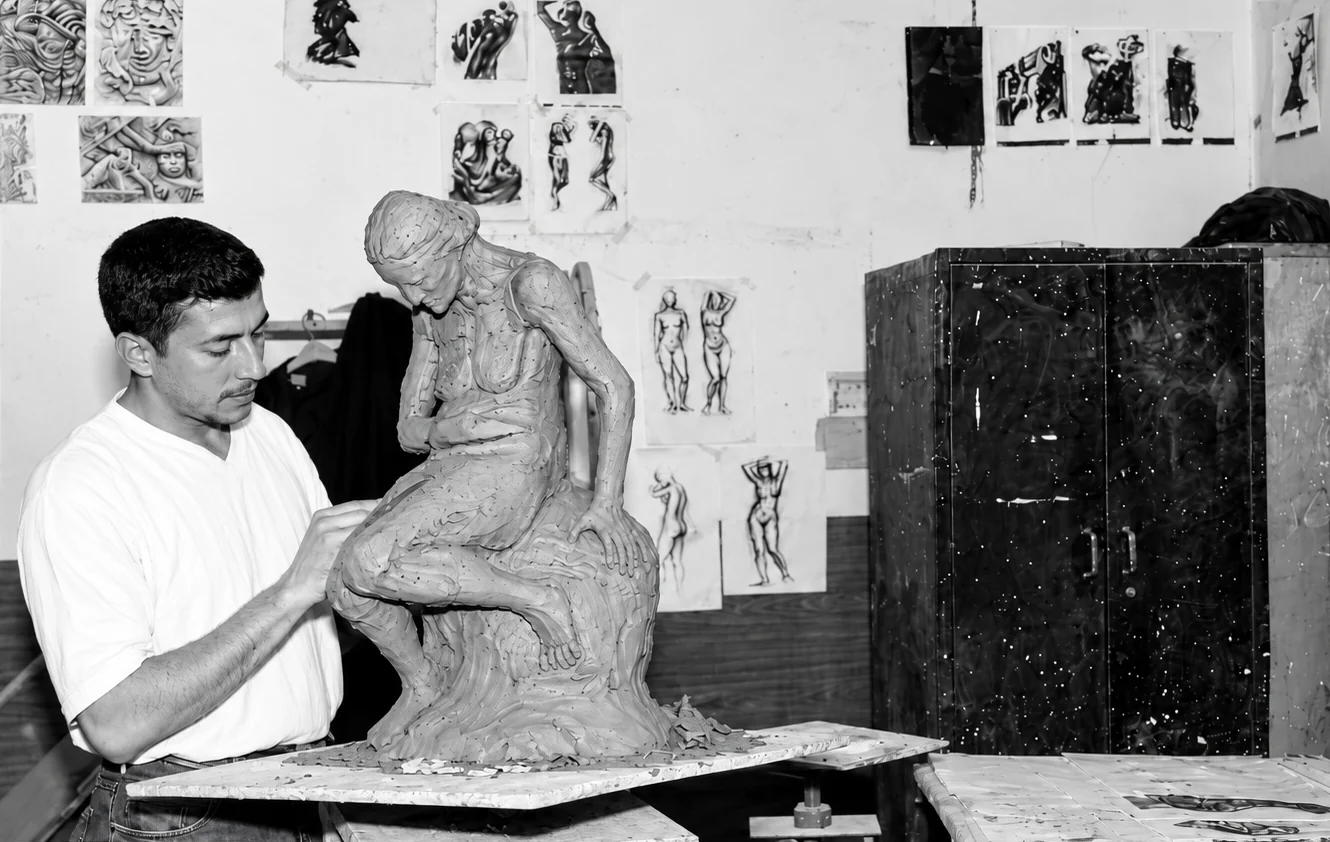
Sculpture became a language through which I could understand the world around me. I was fascinated by the human figure, its ability to communicate strength and vulnerability, and the way a single gesture could express emotions that words could not capture.
After completing my degree, I began teaching at an art institute in Baghdad. From 2003 until 2007, I taught art while continuing to develop my own artistic practice. Teaching allowed me to share my knowledge with students, but it also strengthened my understanding of art as a form of communication, discipline, and human connection.
As I developed as an artist, I became increasingly interested in the relationship between the human body and the forces that shape our lives. I began to see the figure not simply as a physical form, but as a reflection of memory, struggle, love, connection, and the desire for freedom.
Displacement and Renewal
In 2007, I made one of the most difficult decisions of my life: leaving Iraq. Moving to Amman, Jordan, was not an easy beginning. Leaving behind my homeland, familiar surroundings, students, colleagues, and the life I had built brought uncertainty and emotional challenges. But I carried my artistic ambitions with me, determined not to abandon the path I had chosen.
Jordan became an important chapter in my artistic development. Despite the difficulties of starting over, I continued creating and exhibiting my work. One of the most meaningful achievements of that period was my solo exhibition, Sculpture Codes and Its Continuance, at Foresight Gallery in Amman in 2009–2010. It represented more than a professional milestone. For me, it was an affirmation that art could continue to grow even in the face of displacement and uncertainty.
In 2010, I moved to the United States and began another chapter of my life in the San Francisco Bay Area. Here, I encountered new artistic perspectives, materials, and opportunities. I continued my education and eventually earned my Master of Fine Arts in Sculpture from the Academy of Art University in San Francisco.
Home, Memory, and Belonging
Living between different cultures has gradually transformed my understanding of identity and belonging. I no longer see home only as a geographical place. I see it as something we carry within ourselves—in our memories, relationships, experiences, and the connections we create with others.
This philosophy is central to my artistic practice today. My sculptures often bring human figures together, balancing strength with restraint, closeness with separation, and stability with the desire for movement. In my drawings, the human form intersects with landscapes, architectural structures, and abstract compositions, suggesting the complex relationship between individuals and the worlds they inhabit.
My work with bronze, paper, cardboard, and other materials also reflects my belief that a material’s monetary value does not determine its expressive power. Transformation begins with imagination and the ability to recognize possibilities in what already exists around us.
Material, Form, and Memory
The artistic heritage of ancient Mesopotamia remains an important part of my visual language, while my life in California continues to introduce new perspectives. These two worlds are not separate in my imagination. They exist together, influencing the forms, ideas, and emotions that emerge in my work.
After a lifetime shaped by conflict, displacement, teaching, and rebuilding, I have come to believe that art is not only about creating objects. It is about understanding what it means to be human.
I cannot change the history I lived through, but through art, I can transform those experiences into something that speaks of connection, resilience, and hope.
For me, sculpture is not simply what I do. It is how I understand the world, how I preserve memory, how I share knowledge, and how I continue moving forward.
Mishaal AtheerSan Francisco Bay Area, California